Ottoman Dimensions: 16 to 18 Inches Does Both Jobs
· 8 min read
As an Amazon Associate we earn from qualifying purchases. We work from published measurements and buyer reports, and say so where it matters. If you buy through our links we may earn a commission; it has no bearing on the numbers or the verdict.
The overlap window is two inches wide
You buy a 30-inch square ottoman, push it up to the sofa, and find your heels tip upward when you rest them on it. Nothing is wrong with the ottoman. The mismatch is arithmetic: ottoman dimensions are four separate height requirements wearing one label, and they only agree over a narrow band.
One retailer buying guide publishes a height recommendation per intended use:
- Footrest: 13 to 18 inches
- Extra seating: 15 to 18 inches
- Coffee table: 16 to 18 inches
- Storage: 16 to 20 inches
Intersect all four. You get 16 to 18 inches, a two-inch window in which one piece can legitimately do every job.
What has to be true for that window to exist?
Your sofa seat has to measure roughly 17 to 19 inches. That is the condition most buying guides leave out. The same guide sets the rule that an ottoman should sit level with the sofa seat or slightly below it, never above. Standard sofa seat height runs 16 to 18 inches from the floor to the top of the cushion. On a 15-inch seat, everything tall enough to serve as a coffee table is already too tall to rest your feet on, and the two jobs become mutually exclusive. Then you pick one.
What follows is a sizing method that works backwards from the job, not from a product page. Take the table as a filter rather than a ranking. Architectural Digest's ottoman roundup was published September 4, 2025; this one orders by price, cheapest first, and states what each step up buys. Height is the first cut, and the coffee table height that matches your sofa is the same measure under a different name.
| Product | Product Dimensions | Material | Item Weight | Seat Height | Right for |
|---|---|---|---|---|---|
| ALASDO | 13"D x 17"W x 13"H | — | 4.8 pounds | 13 inches | Best space-saving |
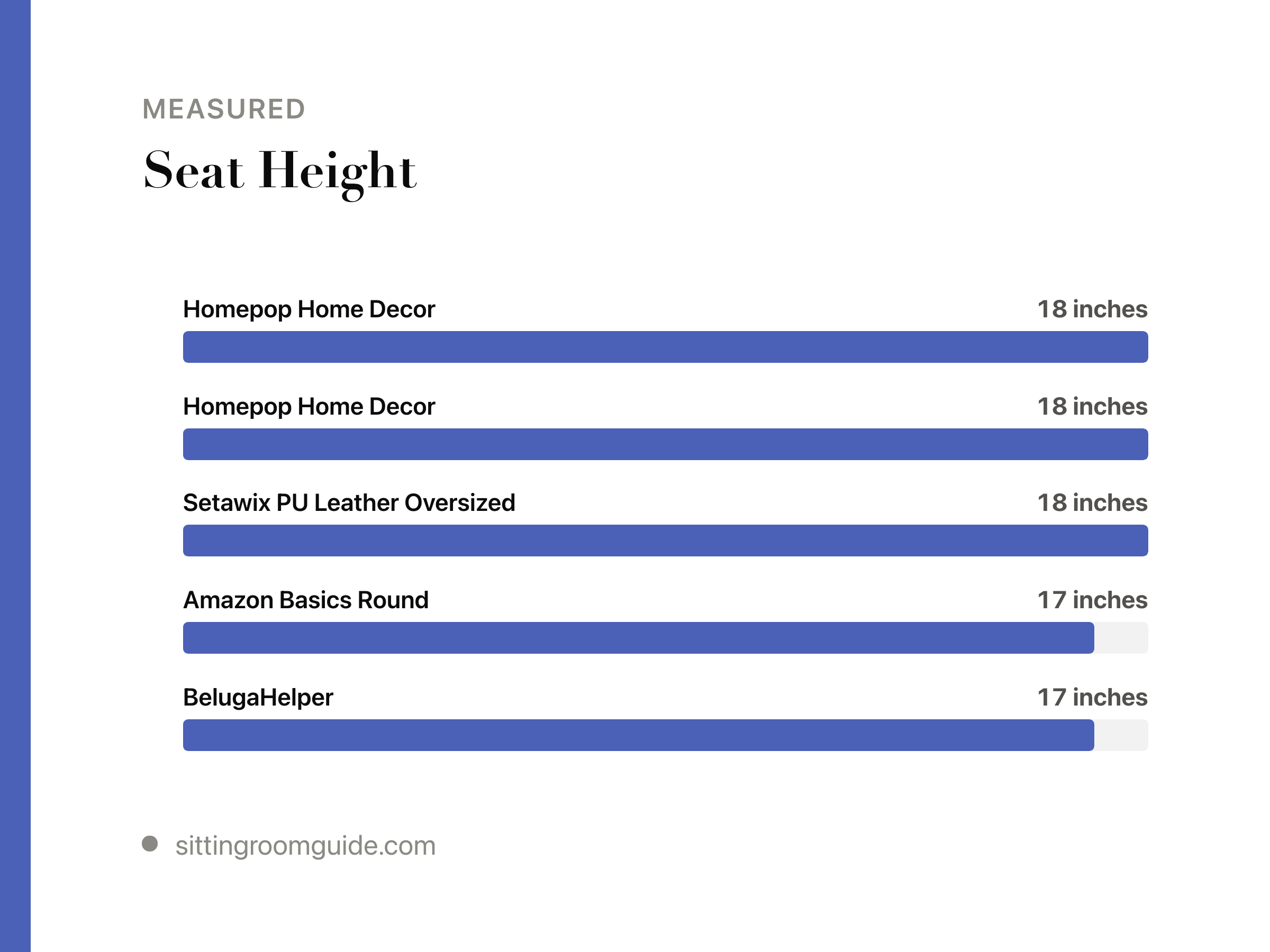
| Amazon Basics Round | 20"D x 20"W x 17"H | — | 9.7 pounds | 17 inches | Best round footstool |
| Homepop Home Decor | 18"D x 24"W x 18"H | — | 22.7 pounds | 18 inches | Best coffee table swap |
| Homepop Home Decor | 30 in. x 17 in. x 16 in. | Polyester upholstery over wood frame | 36.3 pounds | 16 in. | Best sofa-height footrest |
| Busaurus | 49.2 in. x 15.7 in. x 15.7 in. | Linen-look fabric over wood frame | — | 15.7 in. | Best end-of-bed bench |
| Setawix PU Leather Oversized | 43.3 in. x 21.7 in. x 17.7 in. | PU leather | 36.3 pounds | 17.7 in. | Best oversized storage |
| BelugaHelper | 30 in. x 15 in. x 15 in. | Fabric with thick foam padding | 2.23 kg | 15 in. | Best as extra seating |
| 503 - Service Unavailable | 24 in. x 16 in. x 18.5 in. | Upholstered fabric | — | 18.5 in. | Best entryway height |
| Amazon Basics Upholstered | 35.4 in. x 17.7 in. x 16.5 in. | Polyester upholstery over engineered wood | 9.77 kg | 16.5 in. | Best dual-purpose flat top |
| HOMCOM | 25 in. x 15 in. x 15.75 in. | Linen-Touch Polyester Fabric, Rubberwood | 17.2 pounds | 15.75 in. | Best on raised legs |
Every spec above is quoted from the listing; the “Right for” column is our judgement.
The short version
- The pick: ALASDO, for someone in a small flat or dorm who needs a footrest that folds flat to 2.5 inches thick and disappears when guests are gone.
- Also worth it: Amazon Basics Round, for a reader who wants a footrest that doubles as extra perch seating in a tight traffic path, where a round edge beats a corner.
- How this was decided: published specifications and buyer reports across 10 products, compared below.
Three measurements to take before you shop
Three numbers decide whether an ottoman works, and two of them are usually taken wrong. Take them before you look at a single listing.
- Loaded seat height, not empty seat height. Poly & Bark's method is to measure floor to cushion top, then subtract 1 to 2 inches. No source says whether to measure the cushion empty or compressed, so if your seat is soft enough to sink noticeably under an adult, measuring it loaded is the more cautious reading of the rule.
- Clearance, split by function rather than averaged. Poly & Bark publishes 12 to 18 inches between ottoman and surrounding seats; the footstools.co.uk guide sets its minimum at 14 to 18 inches of walking space. The disagreement is only in the low end, and no source explains what the clearance figure is protecting: knee room, walking room, or reach. Which end of the range applies to your room is not something the published guidance settles.
- Distance to whatever the seating faces. Poly & Bark puts 24 to 30 inches between the ottoman and a TV or fireplace on the far side.
The footstools.co.uk guide is tighter for footrest use: about 1 inch below seat height, with the total gap inside 2 to 3 inches either way. That "either way" sits awkwardly against the same guide's "never taller" rule. Poly & Bark's floor is looser, at least one inch shorter than the surrounding seats, with no ceiling stated.
Write down the compressed figure. It is the number the next section works from, and it is the one that decides whether a piece can do both jobs. If you are also replacing the table it stands in for, coffee table height matched to your sofa uses the same measure.
Which one is yours
- Least seat height: ALASDO at 13 inches.
- The middle of the range: HOMCOM at 17 inches.
- Most seat height: Setawix PU Leather Oversized at 18 inches, worth it for you want the biggest wipe-clean storage box.
Why height above the seat hurts, and what a 14-inch sofa forces you to do
The "never taller than the seat" rule is framed as more than visual, though no source supplies a supporting measurement or authority for the mechanism. The footstools.co.uk guide puts the rule as slightly shorter than or level with the seat, never taller. Poly & Bark frames the same one inch of clearance as ergonomic rather than decorative, and specifically warns of back or hip pain when an ottoman matches or exceeds seat height.
Architectural Digest describes one 13-inch-high, 26.5-inch-square model marketed specifically on the slope it gives resting feet.
One consequence follows from the published ranges. A sofa with a 14 to 15-inch seat forces an ottoman under that height, which falls below the 16-to-18-inch coffee-table band, so the dual-purpose compromise is not available. Nothing in the published guidance addresses how such a sofa changes the rules, so the workaround, a low ottoman plus a separate surface, is inference rather than sourced advice.
Low, wide ottomans do exist in that band. Architectural Digest lists one at 14⅞ inches high by 25½ wide. coffee table height depends on your sofa covers that pairing in depth.
When the half-sofa-length rule stops fitting the room
The rule runs out of floor.
Poly & Bark sizes an ottoman at half to two-thirds the couch's length, on the reasoning that it keeps the surface within arm's reach of every seat. The footstools.co.uk guide measures differently: roughly two-thirds the width of the seat cushions rather than the overall footprint. The two rules give materially different numbers on any sofa with arms, and no source says which measurement to take or why.
Poly & Bark notes that an oversized ottoman in a small room reads as lopsided.
No source recommends splitting the piece in two, though a 24-inch square is cited as roughly one seat cushion's width on a sofa under 60 inches. Poly & Bark also points out that round pieces move more easily in tight rooms than square ones, which is an argument for a small round piece in a narrow traffic path.
Bed ends follow different logic. Sofa-seat height is irrelevant here: Poly & Bark matches the bed's width and sits the top 2 to 3 inches below the bed, while another retailer guide argues for slightly narrower than the bed for balance. The two rules conflict and no source resolves them.
Which of these ten suits which job
Start from the sofa seat.
If yours measures 17 to 19 inches, you are inside the two-inch window and can shop for both jobs at once. The evidence file supports no named products or their specifications, and it records that weight capacity is unaddressed for the ottomans in the source set, so no load ratings can be stated here.
Below a 17-inch seat, stop asking for both. Pick the footrest and accept it will not double as a surface. For a sectional layout, the footstools.co.uk guide says a modular corner sofa needs a square footstool of 30 x 30 or 36 x 36 inches, because anything smaller looks lost in the layout.

The dimensions cited here come from published retailer and editorial guidance, including Architectural Digest's ottoman guide of September 4, 2025. No industry or ergonomic standards body is cited by any of these sources, so the ranges are effectively retailer conventions. Measure your own seat height before you trust any of it — the two-inch window follows from the published ranges, but it is your own sofa seat that decides whether you have one.
Which one, then?
ALASDO, best for someone in a small flat or dorm who needs a footrest that folds flat to 2.5 inches thick and disappears when guests are gone.
A different situation changes the pick:
- For a reader who wants a footrest that doubles as extra perch seating in a tight traffic path, where a round edge beats a corner: Amazon Basics Round.
- For someone who actually wants the ottoman to stand in for a coffee table, needing a broad flat 24-inch top rather than a footstool: Homepop Home Decor.
- For you want a footrest that lines up with a standard sofa seat height and hides throw blankets inside: Homepop Home Decor.
Before you order the ALASDO: 13" height is too low to work as a coffee table beside a standard sofa
Questions
What is the standard size for an ottoman?
There is no single standard. Published retailer guidance sets height by use: 13 to 18 inches as a footrest, 15 to 18 inches for extra seating, 16 to 18 inches as a coffee table, and 16 to 20 inches with storage. Widths commonly range from 24-inch squares to 36-inch squares for sectionals.
How tall should an ottoman be to use as a coffee table?
Sixteen to 18 inches, according to published buying guides. That band must also sit level with or slightly below your sofa cushion, so it only works on a seat measuring roughly 17 to 19 inches. On a lower sofa, a coffee-table-height ottoman will be too tall to rest feet on comfortably.
Can one ottoman work as both a footrest and a coffee table?
Only between 16 and 18 inches high, where the footrest and coffee-table ranges overlap. That two-inch window also requires a sofa seat of about 17 to 19 inches. Below a 17-inch seat, the two jobs become mutually exclusive and you should choose a footrest plus a separate surface.
How much space should you leave between an ottoman and the sofa?
Published figures range from 12 to 18 inches, with one guide setting a 14-to-18-inch minimum for walking space. Allow 24 to 30 inches between the ottoman and whatever the seating faces, such as a TV or fireplace. No source specifies whether the gap protects knee room or foot traffic.
How big should an ottoman be compared to the couch?
One rule sizes it at half to two-thirds the couch's overall length so the surface stays within arm's reach. Another measures roughly two-thirds the width of the seat cushions only. On a sofa with arms these give different numbers; a 24-inch square suits couches under 60 inches.
Sources
- How To Pick The Best Ottoman Size & Height | Vale Footstools accessed 2026-08-04
- 13 Best Ottomans That Offer Stealthy Storage (2025) | Architectural Digest accessed 2026-08-04
- Ottoman and Coffee Table Size Measurements For Your Space accessed 2026-08-04
- Ottoman and Coffee Table Size Measurements For Your Space accessed 2026-08-04
- Storage Ottomans: The Ultimate 2026 Buyer's Guide | Joybuy accessed 2026-08-04