What Living Room Cord Length Do You Actually Need?
· 9 min read
As an Amazon Associate we earn from qualifying purchases. We work from published measurements and buyer reports, and say so where it matters. If you buy through our links we may earn a commission; it has no bearing on the numbers or the verdict.
The reach map: why a code-built wall almost never needs an extension cord
A lamp's 6-foot cord and a code-built wall look, on paper, as though they were designed to meet. The living room cord length question only becomes real when furniture, glass or a floating layout puts the lamp somewhere the wall was never wired to serve.
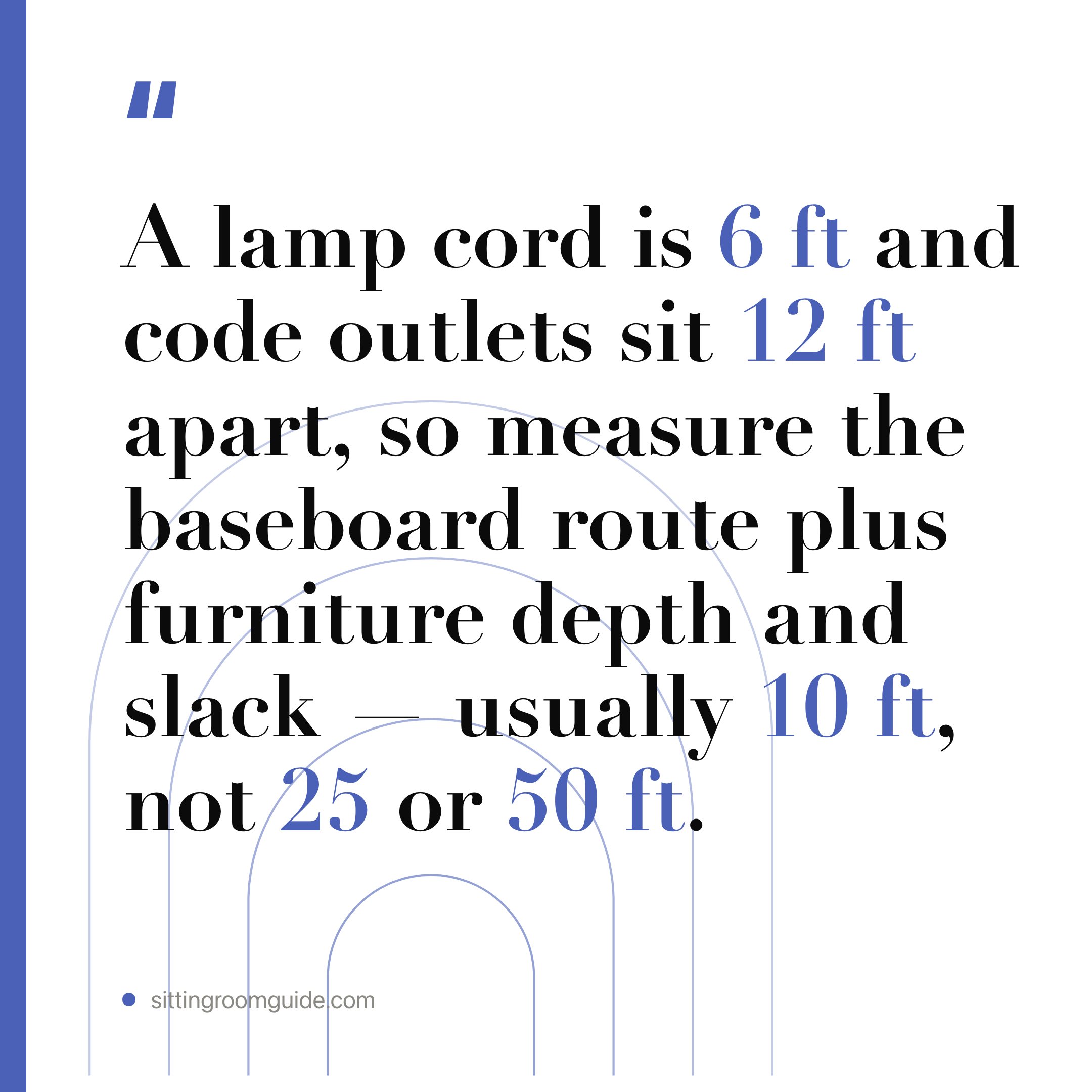
The math is straightforward. A lamp cord measured from the base of the lamp is standardly 6 feet, and the Philco radio forum's line-cord discussion notes that internal chassis wiring can eat a foot or more of that, which is why replacements are sold at 7, 8 feet, or longer. Against that, the National Electrical Code has required since at least 1952 that receptacles sit no more than 12 feet apart along a wall and no more than 6 feet from any break or obstruction.
Four layouts can put a lamp outside easy reach of a wall outlet:
- The floating sofa. Seating pulled well off the wall puts the side table beyond the reach of a standard lamp cord.
- A console against a windowed wall. A window is a break in the wall, and the nearest outlet can sit past its far edge.
- The TV wall. Outlets exist, then the media unit covers them.
- The sofa back over the outlet. The receptacle is in reach and unusable, which is a clearance problem more than a length one.
Get the layout right and the console table height behind a sofa usually settles the rest.
| Product | Material | Item Weight | Color | Unit Count | Right for |
|---|---|---|---|---|---|
| Cordinate | — | 12.8 ounces | White | 1 Count | Best indoor reach |
| Sleek Socket Original | — | 5.76 ounces | White | 1 Count | Best flush-to-wall |
| D-Line Cable | ABS Plastic | 10.24 ounces | Black | 1 Count | Best cord concealer |
| D-Line 6ft | Polyvinyl Chloride | 8.11 ounces | Black | 6 Feet | Best floor crossing |
| Abnii | Metal Plastic | 208 g | White | 1 Count | Best baseboard routing |
| Heavy-Duty Wrap-It Storage Straps | Metal, Polypropylene (PP) | 22.68 g | Black | 6 Count | Best slack storage |
| Iron Forge | — | — | Yellow | 50 Feet | Best heavy-duty run |
Every spec above is quoted from the listing; the “Right for” column is our judgement.
The short version
- The pick: Cordinate, for reaching a lamp on the far side of a living room from a wall outlet without pulling the sofa away from the wall.
- Also worth it: Sleek Socket Original, for a lamp or console that has to sit directly in front of the room's only outlet, where a normal plug would stop the furniture from going flush.
- How this was decided: published specifications and buyer reports across 7 products, compared below.
Measuring the route, not the diagonal
Measure the route a cord will actually take, not the gap it crosses. A tape run along the baseboard, around the door casing and up the leg of the console gives a number above the diagonal, and that is the number to buy against.
The rule, in order:
- Measure along the baseboard, following the path the cord will lie on, not the straight line between outlet and lamp.
- Add the detours: door casings, floor registers, and the depth of any furniture the run passes behind. A sofa in the way adds roughly its own depth.
- Add slack at each end, at the outlet for plug clearance and at the lamp so the base can be moved without tugging.
- Then round up to a stocked length.
Where "buy the shortest cord" fails
Harbor Freight's buying guide already qualifies the advice: pick the shortest cord that still routes around walkways without stretching or straining it. TDDL Cable goes further, telling buyers to measure outlet-to-device and choose a length with no excess slack. Americord states plainly that the ideal cord length is zero.
Indoors, taken literally, that may be the wrong rule. A cord pulled taut on the diagonal crosses the walking line, and Wirecutter's reason for preferring a flat plug is that half-plugged cords and damaged wiring raise fire risk. Harbor Freight's own framing, the shortest run that still routes around walkways without straining, points to a baseboard route. Wirecutter's indoor pick is the Cordinate 10 ft cord.
Lamp cords are the awkward case, because lamps sit away from walls. The Gold Hive routes them under the edge of a rug; check your rug pad thickness against door clearance before adding another layer to the stack.
Which one is yours
- Least global trade identification number: Cordinate at 00030878379144.
- The middle of the range: D-Line 6ft at 00841231233870.
- Most global trade identification number: Heavy-Duty Wrap-It Storage Straps at 20854059003017, worth it for storing the long cord you only drag out occasionally.
Voltage drop at lamp wattage: the number nobody publishes
TDDL Cable warns that longer cords produce voltage drops that make appliances less effective, dimmer lights and slower fans, and Harbor Freight's buying guide of June 17, 2026 says added length causes voltage drop that can reduce performance or make motors harder to start. Neither source gives a distance at which the effect becomes measurable. Neither says whether the warning applies at all to a short run carrying a lamp-and-charger load.
Heavier loads are a different matter. Wirecutter's guide, updated July 31, 2026 by Doug Mahoney, is blunt about the endpoint: too much power through a too-small conductor melts the jacket and exposes bare wire. Harbor Freight bands lengths accordingly: under 25 ft for consistent power, 25 to 50 ft for reach, 50 ft and above where drop increases.
Coiling
TDDL Cable's guidance is that cords should be fully uncoiled before use, alongside never daisy-chaining them and never running them under carpets or chairs. No source in view distinguishes the advice by load, or gives a minimum safe coil diameter. The Wrap-It straps, which wrap bundles to 2.9 in, are for the cord you have unplugged.
Seven products against the same four criteria
Four criteria separate these seven items: reach in feet, load ceiling in watts or amps, whether installing them leaves a mark, and which part of the route they solve.
- Cordinate 3 Outlet Power Strip Surge Protector — 10 ft at 16 gauge, and the only item here that adds both reach and outlets. Wirecutter names the 10-foot Cordinate Décor Extension Cord with 3 Grounded Outlets as its pick for indoor use powering just a lamp or phone charger. Its stated reason for preferring a flat plug is that the plug is less likely to be bumped out of the socket by furniture, pets, or people. Reversible, no marks. If your problem is a lamp on the far wall, this is the one that solves it.
- Sleek Socket Outlet Concealer — covers the receptacle rather than plugging into it visibly. Best where the furniture stands on top of the outlet. Its length and amp rating are not verified here.
- D-Line Cable Management Box, Large — adds no length at all. It hides a strip and its slack on a floor or shelf. Its dimensions and materials are not verified here.
- D-Line 6ft Floor Cord Cover — a floor channel for crossing open floor. Its cavity dimensions and capacity are not verified here.
- Abnii Cable Nails Clips — nail-in clips that fasten wiring to a wall and leave permanent holes. Quantities, sizes and materials are not verified here.
- Wrap-It Storage Straps, 10 in — reusable hook-and-loop straps for storage only. Quantity and load rating are not verified here. The Gold Hive's rule applies: velcro for anything that gets moved often, zip ties for what stays put.
- Iron Forge 12 Gauge, 50 ft — Wirecutter notes a 12-gauge cord at 50 feet handles 15 amps, matching most residential breakers and many older fuses. This product's wattage, listing and temperature ratings are not verified here.
This comparison is built on published specifications and manufacturer ratings, not on bench measurement. Nothing here was loaded, timed or thermally tested.
Renters, one outlet, and the load ceiling of a shared cord
A rented apartment with one outlet on the long wall, a floor lamp beside the sofa and a table lamp on the console: two lamps, one receptacle, and no permission to open the wall. Designer Galey Alix, writing in Apartment Therapy, makes the constraint explicit. Renters typically cannot open up walls to hide wiring. So the routing has to happen on the surface, and the number of lines crossing the floor is the thing you control.
That argues for one cord with several grounded outlets over two shorter ones chained end to end. Americord's guidance is direct: connecting more than one extension cord together to gain reach can cause an electrical fire, and TDDL Cable likewise says they should never be daisy-chained. Wirecutter's indoor pick is a 10-foot cord with three grounded outlets: the Cordinate.
How much can share one cord?
Wirecutter notes that a lamp, a phone charger and a small speaker together are unlikely to draw more than 7 A, which is why a 15 A rating matters less for that kind of indoor run. Beyond that, the sources are clear about the direction of risk:
- Pulling too much power through a too-small gauge makes it heat up, eventually melting the jacket and exposing bare wiring.
- TDDL Cable's rule of thumb is a rating at least 25% above the appliance's total power draw.
- Anything with a heating element, a motor or a compressor is better on its own heavier-gauge run.
Alix's rule for the leftover: combine and condense, then cover. Zip-tie the slack, set a long narrow basket on the console's bottom shelf, and the visible footprint shrinks to one braided line along the baseboard.
So: back to the 6-foot lamp cord and the code-built wall that was meant to meet it. Where they do meet, the honest answer is to move the lamp before buying anything. When the layout will not allow that, a sofa floating on a rug, a console on a wall with one receptacle, buy the shortest length that reaches along the baseboard, not the shortest that reaches. The measure that decides it is the route, and the one worth checking first is how far the console sits from the wall.
Which one, then?
Cordinate, best for reaching a lamp on the far side of a living room from a wall outlet without pulling the sofa away from the wall.
A different situation changes the pick:
- For a lamp or console that has to sit directly in front of the room's only outlet, where a normal plug would stop the furniture from going flush: Sleek Socket Original.
- For when the extra cord length and the power strip itself both need to disappear behind a TV stand or side table: D-Line Cable.
- For a lamp cord that has to cross open floor to reach a seating area, where the run is a trip hazard rather than an eyesore: D-Line 6ft.
Before you order the Cordinate: 16-gauge, 1625 W — sized for lamps and electronics, not heaters or power tools
Questions
How long should an extension cord be for a living room lamp?
Measure the route the cord will lie along — the baseboard, around door casings, behind furniture — then add slack at the plug and the lamp, and round up to a stocked length. For most floating sofas or consoles that lands at 10 feet, not the 25 or 50 feet sold for reach.
How long is a standard lamp cord, and how far apart are outlets?
A standard lamp cord measures about 6 feet from the base, though internal chassis wiring can consume a foot or more, which is why replacements sell at 7 or 8 feet. The National Electrical Code has required since 1952 that receptacles sit no more than 12 feet apart and within 6 feet of any wall break.
Do I need a thicker gauge cord if it is longer?
For heavier loads, yes: pushing too much current through a too-small conductor heats the jacket and can expose bare wire. A 12-gauge cord at 50 feet handles 15 amps. But a lamp, phone charger and small speaker together rarely draw more than 7 amps, so gauge matters less on short indoor runs.
Sources
- Designer Advice to Fix a Living Room Cable & Cord Chaos | Apartment Therapy accessed 2026-08-05
- How to Hide Cords in Every Room — What Actually Works — The Gold Hive accessed 2026-08-05
- The 4 Best Extension Cords for Your Home and Garage of 2026 | Reviews by Wirecutter Advertisement accessed 2026-08-05
- Line Cord Length accessed 2026-08-05
- How to Choose the Best Power Extension Cord? | Americord accessed 2026-08-05
- How to Choose the Right Extension Cord for Small Appliances accessed 2026-08-05
- Power Cord Buying Guide - 10 Points To Consider | Americord accessed 2026-08-05
- Extension Cord Buying Guide: How to Choose the Right Cord - Harbor Freight accessed 2026-08-05