Bookshelf Depth: How Deep for Books and Baskets?
· 8 min read
As an Amazon Associate we earn from qualifying purchases. We work from published measurements and buyer reports, and say so where it matters. If you buy through our links we may earn a commission; it has no bearing on the numbers or the verdict.
Measured depths: what you are actually storing
A shelf built for paperbacks will hold a paperback. It will not hold the AV receiver, the LP crate, or the fabric basket you bought to hide the cables. One Woodworking Stack Exchange respondent argues depth should be sized to a collection's largest books, not its average book — and for many households the deepest object on the shelf may be media or storage rather than a book.
That distinction decides whether you build or buy at 9.5, 11.5 or 13 inches. Get it wrong shallow and the basket sits proud of the frame; get it wrong deep and you lose walkway and pay for plywood you never fill. What follows is a single depth list you can measure your own possessions against, then the cost of each extra inch.
Measured front-to-back depths of what people actually shelve:
- Mass-market paperback. This Old House puts the required shelf depth for paperbacks at 5 inches.
- Trade paperback. Tribesigns gives 6.5 to 8 inches of depth for paperback storage generally.
- Standard hardcover. This Old House says 8 inches of depth; Tribesigns says 10 to 12. Both cannot be right, and the gap is covered in the next section.
- Textbook or coffee-table book. Tribesigns asks for 14 inches or more here, and a Woodworking Stack Exchange respondent notes large-format books running 15 inches across.
- A4 or letter binder. Tribesigns recommends 12 to 14 inches for binders and office files, while one guide puts binders and archival materials at 15 to 18 inches.
- LP record. One Belgian maker sells a 35 cm depth for binders, files and LPs.
- Storage baskets and bins. No source in the evidence file gives measured basket depths. Depth for gear is its own problem; see media console depth and the gear inside.
| Product | Product Dimensions | Material | Item Weight | Number of Shelves | Right for |
|---|---|---|---|---|---|
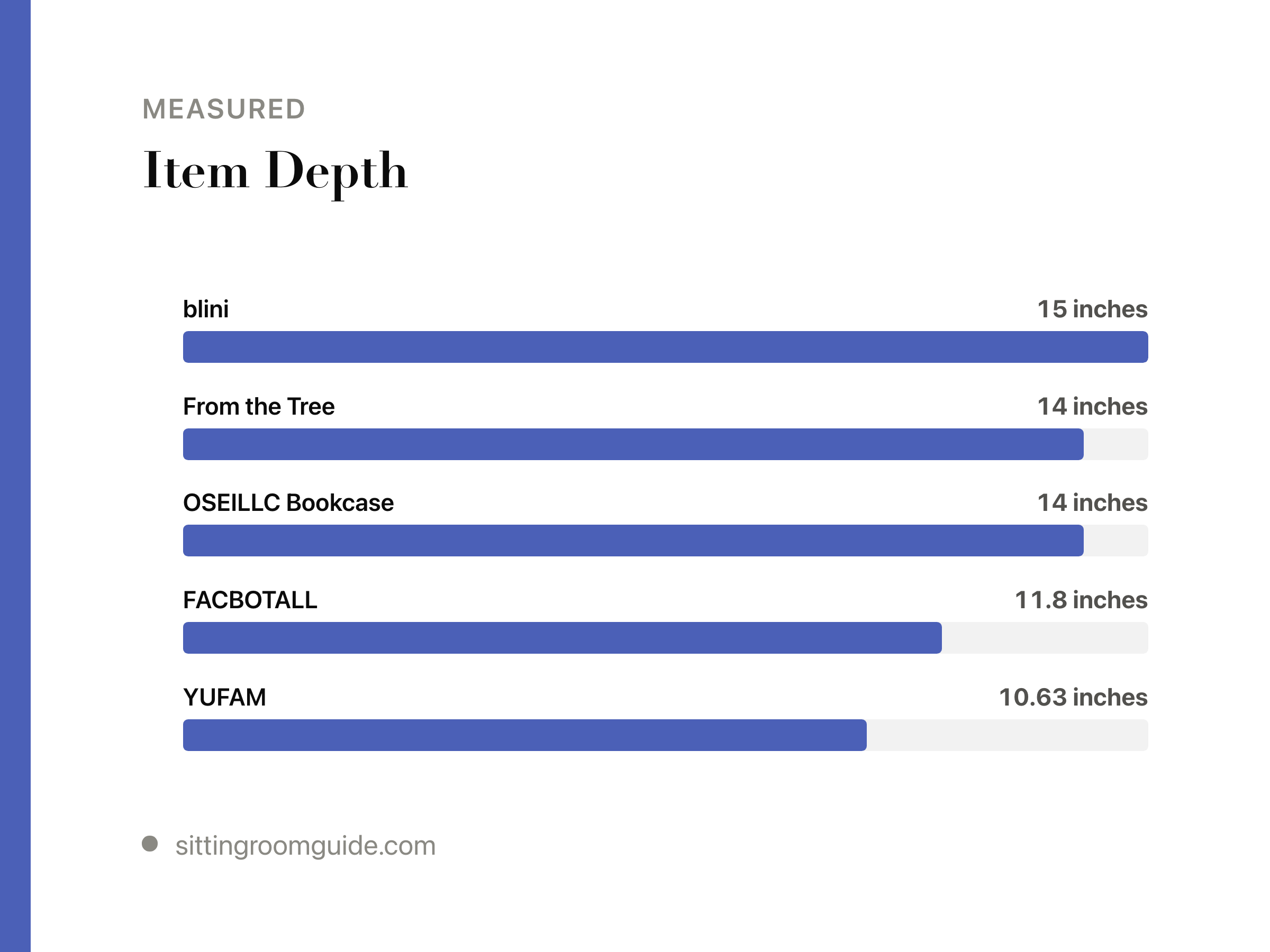
| blini | 30.5 inches x 15.2 inches x 72.2 inches | Engineered Wood | — | 5 | Best multi-depth |
| From the Tree Furniture | 14"D x 31.49"W x 63"H | Pine | 60 pounds | 4 | Best solid wood |
| Furologee | 10.6"D x 15.4"W x 55.5"H | Wood | 18.5 pounds | 5 | Best with drawer |
| OSEILLC Bookcase | 14"D x 33.3"W x 66"H | Metal | 47 pounds | 5 | Best heavy-duty |
| FACBOTALL | 11.8"D x 47.2"W x 74.4"H | PB | 116.2 pounds | 6 | Best wide shallow |
| YUFAM | 10.63"D x 14.96"W x 53.54"H | Wood | 14.6 pounds | 5 | Best narrow slot |
Every spec above is quoted from the listing; the “Right for” column is our judgement.
The short version
- The pick: From the Tree Furniture, for you want real timber and serious load capacity while keeping the footprint to a 14-inch depth in a nursery or kids' room.
- Also worth it: blini, for you want one unit that handles both books and a deep-bodied appliance like a printer or microwave, thanks to a widened lower countertop stepping out to 15 inches of depth.
- How this was decided: published specifications and buyer reports across 6 products, compared below.
Why the published numbers disagree
Three bands circulate, from three kinds of source.
Furniture retailers publish 10–12 inches. Tribesigns gives that figure on its bookcase height page, and This Old House uses the same range, adding that larger books, art or display pieces need more. Hernest splits the same territory three ways: 8–10 inches for slim decorative shelving, 10–12 for standard book storage, 12–15 for heavy or mixed use. Whether the shallow bands reflect shipping and material economics rather than buyer demand is not established by any of these sources.
The 12–15 inch band is presented alongside display and mixed-use framing. Tribesigns states elsewhere that bookshelf depth is usually around 12 to 15 inches — a deeper number than its own other page gives. SICOTAS calls 12–14 inches "friendly" for most books and advises going deeper for oversized art books or baskets.
Woodworkers who measured collections land lower. One Woodworking Stack Exchange answer states standard bookshelves are 11 inches deep; another says 12-inch shelves are too deep for most books, which contradicts the retail 12–15 framing directly. A builder with 40 years and roughly a dozen bookcases behind him uses 11.5 inches and will not go under 11. Another took a tape measure to his own shelves and settled on 9.5.
Advertised depth is not usable depth. George's Furniture puts a nominal 12-inch unit at 10.5–11 inches of usable space once frame, back panel, edging and doors are counted. Builders on Stack Exchange subtract about an inch and a half.
Which one is yours
- Least number of shelves: From the Tree Furniture at 4.
- The middle of the range: OSEILLC Bookcase at 5.
- Most number of shelves: FACBOTALL at 6, worth it for you have a long wall and want maximum shelf run for lightweight paperbacks.
What every extra inch costs
Depth costs floor. No source in the evidence file quantifies the floor-space cost of depth, or minimum walkway clearance in front of a bookcase. George's Furniture puts the practical ceiling at 14 inches for most homes, and says shelves deeper than 12 inches can feel intrusive in narrow rooms.
The double-stacking failure
Woodworking Stack Exchange notes that a 1x12 shelf holds two rows of paperbacks, one upright and a second tilted back in front. Tribesigns puts the problem plainly: items at the back are hard to see and reach, worst on low shelves. The evidence file contains no depth requirement for two full rows of hardcovers, and no source addresses risers or deliberate front-to-back staging.
Span is the other bill
Span decides how much weight a shelf carries before sagging. This Old House gives a 3-foot 1x12 in oak at 313 pounds before it sags a quarter inch; in plywood, 129 pounds; in MDF, 87. Plywood shelves are commonly given a hardwood front edge about 1.25 inches wide to stiffen them against sagging under heavy books.
Six bookcases, compared on depth, span and load
The evidence file contains no product specifications for individual bookcases, so no depth, span or load comparison between named units can be made here. For context, Hernest gives standard bookcase widths as 24–48 inches per unit, and Tribesigns publishes per-shelf capacities by material: particle board 30–50 lbs, plywood 50–80 lbs, solid wood over 100 lbs, metal frames up to 200 lbs. Sellers advise anchoring bookcases taller than roughly 60 inches.
blini — Best multi-depth
- Multi-depth build: 15.2 in. deep overall with a widened countertop sized for a printer, microwave or coffee machine
- Cable hole in the back panel for anything plugged in on the countertop
- But: Engineered wood rather than solid timber
- But: Shelves rated only about 20 lbs each, low for a deep shelf that invites heavy loads
From the Tree Furniture — Best solid wood
- 100% solid pine throughout frame, shelves and back panel — no MDF or particleboard
- 50 lbs per shelf, 200 lbs total, enough for hardcover and cookbook runs
- But: Only 4 shelves across 63 in. of height
- But: About 60 lbs to move and position
Furologee — Best with drawer
- Removable fabric drawer (13.8 x 10.2 x 10.2 in.) hides toys or supplies and works with standard storage cubes
- 10.6 in. depth slips into tight corners and small apartments
- But: Only 15.4 in. wide, so linear book capacity per shelf is small
- But: 30 lbs per shelf limits it to lighter loads
OSEILLC Bookcase — Best heavy-duty
- Steel construction rated up to 180 lbs per shelf
- 14 in. depth with a wide 33.3 in. span, listed as holding up to 160 books
- But: Painted metal look will not blend with wood furniture
- But: Open metal shelving offers no back panel to stop items pushing through
FACBOTALL — Best wide shallow
- 47.2 in. double-wide span across 6 tiers for a lot of linear book storage
- 11.8 in. depth keeps it close to the wall in a hallway or study
- But: Only 33 lbs per shelf — the weakest capacity here despite the width
- But: Particle board construction
YUFAM — Best narrow slot
- 10.63 in. depth and 14.96 in. width fit slots that defeat standard bookcases
- Corner pillars 1.5 times wider than standard solid wood posts for added stability
- But: No stated weight capacity per shelf
- But: No drawer or closed storage, so baskets must be bought separately
Which depth suits which case
The general guidance is easier to summarise than to apply to specific units. Hernest says an 8-inch shelf suits paperbacks, decorative objects and light styling, but not large hardcovers, office binders or deep storage, and concedes 8 inches is a design-focused depth rather than a universal storage solution. George's Furniture warns that narrow 6 to 9 inch shelving is unsuitable for art books, binders and large hardcover collections, and also says anything deeper than 14 inches is rarely necessary in most homes.
Before ordering, check shelf spacing against your tallest spine: George's Furniture says professionals leave 1 to 2 inches of clearance above the tallest book, and that most shelves are spaced 10 to 12 inches apart so books can be removed easily.
Which one, then?
From the Tree Furniture, best for you want real timber and serious load capacity while keeping the footprint to a 14-inch depth in a nursery or kids' room.
A different situation changes the pick:
- For you want one unit that handles both books and a deep-bodied appliance like a printer or microwave, thanks to a widened lower countertop stepping out to 15 inches of depth: blini.
- For you need baskets as well as books in a 10.6-inch gap beside a fireplace or in a corner, with a fabric drawer to hide the clutter: Furologee.
- For you want a 14-inch-deep shelf that will carry a heavy hardback or vinyl collection without any risk of sagging panels: OSEILLC Bookcase.
Before you order the From the Tree Furniture: only 4 shelves across 63 in. of height
Questions
Is 10 inches deep enough for bookshelves?
For most books, yes. Retailers such as Tribesigns and This Old House put standard book storage at 10 to 12 inches, and This Old House says hardcovers need about 8 inches. Ten inches falls short only for textbooks, coffee-table books, A4 binders or LP crates, which want 12 to 15 inches or more.
Can a bookshelf be 8 inches deep?
Yes, but with limits. Hernest says an 8-inch shelf suits paperbacks, decorative objects and light styling, and concedes it is a design-focused depth rather than a universal storage solution. George's Furniture warns that 6 to 9 inch shelving is unsuitable for art books, office binders and large hardcover collections.
What is the difference between bookcase depth and usable shelf depth?
Advertised depth includes the carcass. George's Furniture puts a nominal 12-inch unit at 10.5 to 11 inches of usable space once the frame, back panel, edging and any doors are counted. Builders on Woodworking Stack Exchange simply subtract about an inch and a half from the stated figure.
Why do woodworkers say 12-inch shelves are too deep?
Because books get lost at the back. One Woodworking Stack Exchange answer calls 12 inches too deep for most books; Tribesigns notes items at the rear are hard to see and reach, worst on low shelves. Measured collections lead builders to 9.5 to 11.5 inches instead, with 11 as a floor.
How deep should shelves be for binders, LPs and oversized books?
Deeper than standard. Tribesigns recommends 12 to 14 inches for binders and office files and 14 inches or more for textbooks and coffee-table books; one guide puts archival materials at 15 to 18 inches. One Belgian maker sells a 35 cm depth covering binders, files and LP records.
Sources
- design - Is there an average depth that works best for book shelves? - Woodworking Stack Exchange accessed 2026-08-05
- What is The Best Height For Bookcases?-Tribesigns accessed 2026-08-05
- Bookcase Basics - This Old House Skip to content accessed 2026-08-05
- Dimensions - The Perfect Bookshelf accessed 2026-08-05
- What is The Best Height For Bookcases?-Tribesigns accessed 2026-08-05
- Bookshelf Depth Guide: Standard Sizes & How to Choose - George's Furniture Foshan accessed 2026-08-05
- Height of a Bookcase: Standard Sizes & Expert Guide accessed 2026-08-05
- Bookshelves Buying Guide-Tribesigns accessed 2026-08-05
- Best Height for Bookcases: Room-by-Room Guide – SICOTAS accessed 2026-08-05